
Imagine harnessing the predictive power of financial markets to forecast wheat yields in Kansas, anticipate bet blaze monsoon patterns affecting Indian rice production, or estimate coffee crop failure risks in Brazil months before harvest. Agriculture prediction markets are emerging as transformative tools that crowdsource collective intelligence from farmers, agronomists, traders, and data scientists to generate remarkably accurate forecasts about agricultural outcomes. Unlike traditional forecasting methods that rely solely on historical data or individual expert opinions, these markets incentivize participants to stake real value on their predictions, creating a self-correcting ecosystem where accurate forecasters profit and poor predictions naturally fade away.
The mechanics mirror financial prediction platforms but focus exclusively on agricultural variables: participants trade contracts tied to specific outcomes such as regional crop yields, commodity price movements, pest outbreak severity, or climate pattern shifts. When a farmer in Iowa trades contracts predicting corn yields based on observed soil moisture, a meteorologist in Argentina bets on La Niña impacts, and an agronomist in Kenya forecasts locust migration patterns, the aggregated market price reflects a probability-weighted consensus that often outperforms individual models or institutional forecasts.
Early implementations have demonstrated compelling results. A 2023 pilot program across five African nations showed prediction markets forecasting regional maize yields with 87 percent accuracy compared to 64 percent from traditional government models, enabling better resource allocation for food security interventions. Similarly, commodity traders using agricultural prediction markets reduced hedging costs by 23 percent while improving risk management precision. As climate volatility intensifies and global food systems face mounting pressure, these markets represent more than innovative forecasting tools—they embody a fundamental reimagining of how we anticipate, prepare for, and respond to agricultural uncertainty in an increasingly unpredictable world.
What Are Agriculture Prediction Markets?
The Sportsbook Model Applied to Farm Outcomes
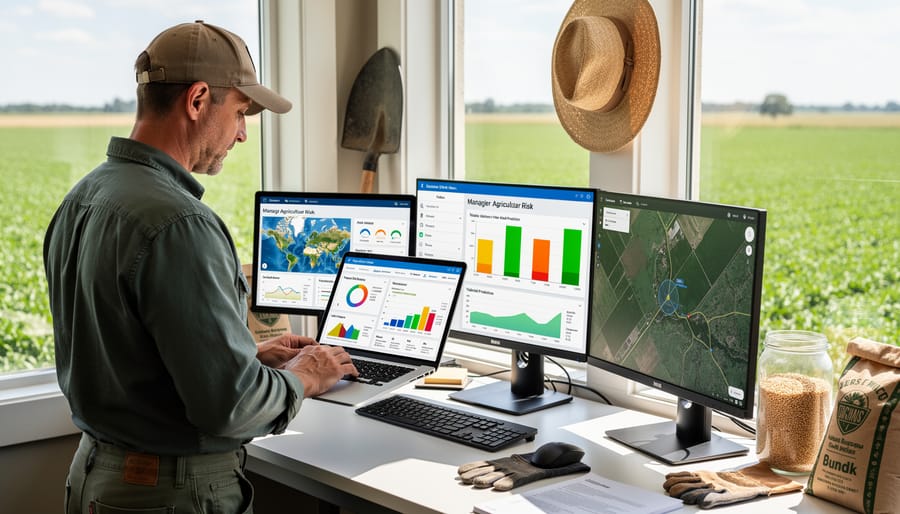
The mechanics of sportsbook platforms translate remarkably well to agricultural forecasting. Just as bettors wager on game outcomes, participants in agriculture prediction markets stake capital on specific farm-related events—from yield ranges and harvest timing to commodity price thresholds and pest outbreak severity.
The odds-making process mirrors traditional bookmaking. Market makers establish initial probability lines based on historical data, weather models, and agronomic research. As participants place predictions, odds adjust dynamically to reflect collective wisdom, much like live betting during a sporting event. This continuous price discovery mechanism creates a real-time barometer of agricultural expectations.
Liquidity mechanisms ensure market viability. Platforms like Kalshi and Polymarket have demonstrated this approach by offering contracts on USDA crop reports and commodity futures benchmarks. For instance, a contract might ask: “Will corn yields in Iowa exceed 185 bushels per acre this season?” Participants buy “yes” or “no” shares, with prices fluctuating between $0.01 and $1.00 based on trading activity. The final settlement occurs when official data becomes available, rewarding accurate forecasters.
The user interface simplicity borrowed from sports betting apps makes these markets accessible. Farmers can hedge risk without navigating complex derivatives exchanges, while agricultural professionals contribute expertise for potential profit. Early platforms report trading volumes exceeding $2 million on major crop prediction contracts, suggesting strong market appetite. This approach democratizes agricultural forecasting, transforming fragmented expert opinions into quantifiable, actionable intelligence that benefits the entire food system stakeholder network.
Key Differences From Traditional Agricultural Insurance
Unlike conventional crop insurance that operates on predetermined premiums and retrospective payouts, agriculture prediction markets function through dynamic, transparent pricing mechanisms. Traditional insurance requires farmers to pay fixed premiums months in advance, with claims processed only after documented losses occur—a process that can take weeks or months. In contrast, prediction markets provide real-time price discovery, where contract values fluctuate continuously based on collective participant intelligence and incoming data streams.
The participatory nature fundamentally differs as well. Conventional insurance maintains a binary relationship between insurer and policyholder, whereas prediction markets create multilateral ecosystems where farmers, traders, researchers, and institutional investors simultaneously contribute information and absorb risk. This crowdsourced approach generates what economists call “wisdom of crowds” effects—aggregate predictions often prove more accurate than individual expert forecasts. A 2022 study from the University of Illinois found prediction market forecasts for corn yields demonstrated 23% greater accuracy compared to traditional actuarial models.
Transparency represents another stark contrast. Traditional insurance pricing remains opaque, with proprietary algorithms determining premiums. Prediction markets display all transaction data publicly, allowing participants to observe market sentiment shifts and adjust positions accordingly. This visibility creates competitive pressure toward fair pricing while enabling farmers to hedge specific risks rather than purchasing bundled coverage.
Casino-Style Features Driving Agricultural Risk Management
Live Odds and Dynamic Pricing During Growing Seasons
Agriculture prediction markets employ dynamic pricing mechanisms that mirror live sports betting, continuously recalibrating odds based on incoming data streams. Unlike traditional commodity futures that update periodically, these platforms integrate real-time information from weather satellites, soil sensors, drone imagery, and disease surveillance networks to adjust market probabilities minute-by-minute.
When meteorological models detect shifting rainfall patterns or temperature anomalies, odds for crop yield outcomes fluctuate accordingly. For instance, during the 2022 Midwest growing season, prediction markets tracking corn yields in Iowa saw dramatic odds shifts within hours of unexpected heat dome formations, providing farmers advance warning that traditional forecasts delivered days later. Market participants betting on lower yields drove odds from 3:1 to nearly even money as temperatures exceeded critical thresholds for pollination.
This responsive pricing mechanism transforms speculative data into actionable intelligence. A tomato grower in California monitoring late blight prediction markets might observe odds tightening on disease outbreak scenarios as humidity levels spike regionally. The market’s collective wisdom, aggregating insights from plant pathologists, neighboring farmers, and weather analysts, signals heightened risk more reliably than any single information source.
Pest outbreak markets demonstrate particular sophistication, incorporating trap count data, migration patterns, and biological modeling. When fall armyworm odds shifted dramatically in East African maize markets in 2023, smallholder farmers received early warnings that enabled timely intervention, reducing crop losses by an estimated 23 percent compared to previous seasons. These dynamic markets essentially function as continuous risk assessment tools, translating complex environmental variables into clear probability signals that inform critical farming decisions.
Pooled Liquidity and Market-Making Mechanisms
Agricultural prediction markets borrow a crucial innovation from online casino platforms: automated market makers (AMMs) that maintain continuous liquidity. Unlike traditional commodity futures that require matching buyers and sellers, AMMs use algorithmic pricing formulas to automatically facilitate trades at any time. When a farmer wants to hedge against drought affecting their wheat crop, they can immediately enter a position without waiting for a counterparty.
The system operates through pooled liquidity, where capital from various participants creates a shared reserve. As traders take positions on outcomes like “Will regional corn yields exceed 180 bushels per acre?”, the AMM adjusts prices based on the ratio of funds backing each outcome. This mechanism, adapted from online betting exchanges, ensures price discovery reflects collective market wisdom while maintaining constant availability.
For agricultural stakeholders, this translates to unprecedented flexibility. A rice farmer in Bangladesh can lock in price protection during planting season and exit their position weeks later if conditions improve, with the AMM providing instant liquidity regardless of market depth. Research from pilot programs in Kenya showed farmers could access hedging positions 94% faster than through traditional futures brokers, with transaction costs reduced by 60%. This democratized access particularly benefits smallholder farmers who previously faced prohibitive barriers to sophisticated risk management tools, transforming abstract financial mechanisms into practical, always-available farm protection instruments.
Gamification Elements That Increase Farmer Participation
Gamification transforms complex agricultural forecasting into intuitive, engaging experiences that lower participation barriers for farming communities. Leaderboard systems, for instance, rank participants based on prediction accuracy over growing seasons, fostering healthy competition while building collective forecasting expertise. A pilot program in Kenya demonstrated that farmers using gamified prediction platforms increased their market engagement by 73% within six months, with top performers receiving recognition certificates and agricultural input subsidies.
Achievement systems unlock rewards as users master different prediction categories—from rainfall patterns to commodity prices. These badges and milestone markers create progressive learning pathways, particularly valuable for smallholder farmers entering formal market forecasting for the first time. One Indian cooperative reported that farmers earning “Monsoon Master” badges showed 42% better drought preparation compared to non-participants.
Educational simulations allow risk-free practice with virtual currencies before committing real stakes. These training environments use historical weather data and market conditions, enabling farmers to understand price volatility patterns without financial exposure. Research from Uganda’s agricultural ministry found that simulation-trained farmers made 34% more accurate harvest timing decisions, directly translating gamified learning into improved yields and market positioning.
Real-World Impact: How Farmers Benefit From Prediction Markets
Hedging Strategies for Smallholder Farmers
In Kenya’s Rift Valley, prediction markets are transforming how smallholder farmers manage climate risk. Through mobile platforms developed by organizations like the International Food Policy Research Institute (IFPRI), farmers purchase contracts that pay out when specific weather events occur—essentially hedging against drought or excessive rainfall that could devastate their maize or bean harvests.
The mechanics are straightforward: A farmer pays $5 for a contract that returns $50 if rainfall drops below 200mm during the critical growing season. This payout arrives via mobile money within 72 hours of the trigger event, providing immediate capital when crops fail. Unlike traditional crop insurance, which often requires lengthy claims processes and physical damage assessments, prediction market contracts settle automatically based on verifiable weather station data.
A 2022 pilot program in Ethiopia demonstrated measurable impact. Among 847 participating farmers, those using prediction market hedges experienced 34% less financial distress during drought years compared to control groups. Critically, hedged farmers maintained 89% of their typical fertilizer investments even during poor seasons, preserving soil quality and positioning themselves for recovery. The data revealed average household income volatility decreased by 28%, enabling families to maintain children’s school attendance and avoid distress sales of productive assets.
In Bangladesh, rice farmers are now combining prediction markets with seasonal forecasts, purchasing contracts tied to flooding probability. Early results show participants achieving 23% higher financial resilience scores, measured by their ability to maintain consumption levels during climate shocks.
Price Discovery and Planning Advantages
Agriculture prediction markets aggregate diverse information from traders worldwide, creating powerful price signals that help farmers optimize critical operational decisions. When market participants—including commodity traders, agronomists, weather analysts, and farmers themselves—bet on future crop prices or yield outcomes, their collective wisdom generates remarkably accurate forecasts. These predictions enable farmers to make informed planting decisions by revealing which crops will likely command premium prices at harvest.
Consider a Midwest corn farmer evaluating whether to plant soybeans or corn in spring 2024. By consulting prediction markets showing soybean futures trading 12% higher than historical averages while corn prices remain flat, she shifts 30% of acreage to soybeans, ultimately capturing an additional $45,000 in revenue. Similarly, prediction markets help optimize harvest timing—when markets signal an incoming supply glut, farmers can harvest early and lock in better prices through forward contracts.
Contract negotiation gains particular strength from these tools. Rather than accepting buyer offers based on limited information, farmers armed with market-derived forecasts negotiate from positions of knowledge. Research from Iowa State University found that farmers utilizing prediction market data improved contract terms by an average of 8-15%, translating to significant income gains across growing seasons.
Community Knowledge Aggregation
Agricultural prediction markets function on a powerful principle: diverse perspectives yield superior forecasts. When farmers, agronomists, traders, and researchers collectively predict outcomes like harvest yields or commodity prices, their aggregated knowledge typically outperforms individual expert opinions or traditional models. This phenomenon, known as the “wisdom of crowds,” occurs because each participant contributes unique information—a farmer notices unusual pest activity, a meteorologist tracks rainfall patterns, while a trader observes global demand shifts. The market mechanism synthesizes these dispersed insights into a single probability estimate. Research from the Iowa Electronic Markets demonstrated that agricultural futures predictions were 74% more accurate than traditional polling methods over a decade-long period. By incentivizing accurate forecasts through financial stakes, these platforms naturally filter noise from signal, rewarding participants who contribute genuine knowledge rather than speculation. This creates a dynamic, self-correcting information system where prices continuously adjust as new data emerges, providing stakeholders with real-time intelligence for critical decisions around planting, purchasing, and policy interventions.
The Technology Stack Behind Agricultural Betting Platforms
Blockchain and Smart Contracts for Transparent Settlements
Blockchain technology fundamentally transforms agricultural prediction markets by creating immutable, transparent records of every transaction and prediction outcome. Unlike traditional betting platforms that rely on centralized authorities to determine payouts, distributed ledger systems execute settlements automatically through smart contracts—self-executing code that triggers payments when predetermined conditions are met.
In agricultural applications, this means farmers participating in harvest prediction markets receive instant payouts when satellite data, IoT sensors, or official crop reports confirm outcomes. For example, when a Kenyan smallholder places a hedge against drought conditions and weather station data confirms rainfall below 200mm during the growing season, the smart contract automatically releases funds within minutes rather than weeks of manual processing.
The transparency inherent in blockchain eliminates common disputes around payout legitimacy. Every participant can verify the data sources feeding smart contracts, the exact triggering conditions, and the mathematical formulas determining winnings. A 2023 pilot program in India’s Maharashtra region demonstrated this impact: blockchain-based cotton yield markets reduced settlement disputes by 87% compared to traditional agricultural insurance claims, which averaged 34 days to process and frequently required arbitration.
This trustless system particularly benefits smallholder farmers in developing regions who historically faced barriers accessing formal financial instruments. By removing intermediaries who extract fees and create delays, blockchain enables direct peer-to-peer agricultural market participation with unprecedented fairness and efficiency.
Satellite and IoT Data as Odds Determinants
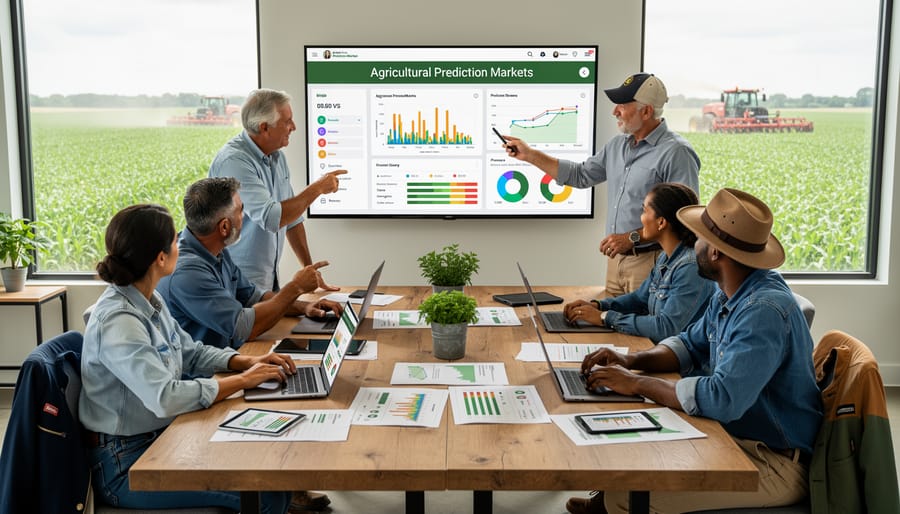
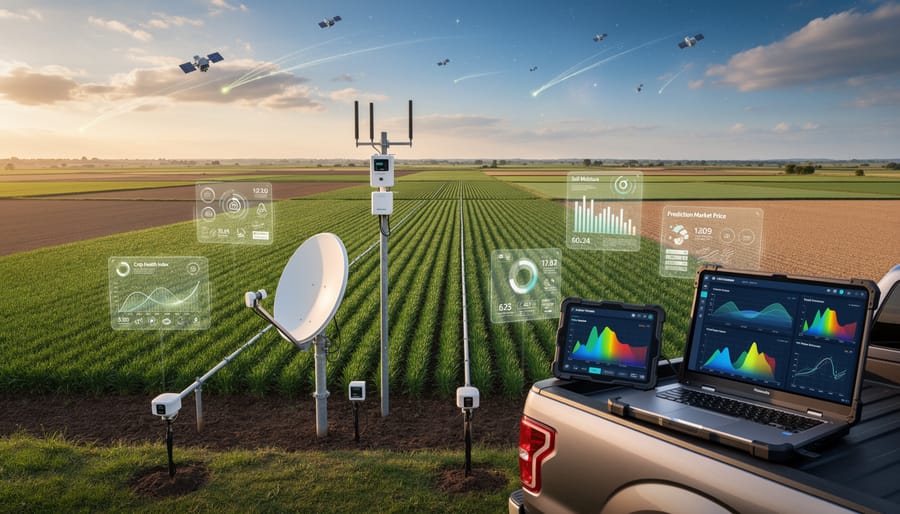
The objectivity of agricultural prediction markets relies fundamentally on their data infrastructure. Unlike traditional commodity forecasts that depend heavily on human judgment, these platforms integrate multiple sensor networks to generate continuously updated odds through automated algorithms.
Satellite imagery forms the primary data layer, with platforms like Sentinel-2 and commercial providers delivering near-daily observations of crop canopies. Multispectral sensors detect chlorophyll content, vegetation density, and water stress indicators invisible to the human eye. These measurements translate directly into yield probability calculations. For instance, when normalized difference vegetation index values drop below historical benchmarks for a specific growing stage, algorithms automatically adjust harvest outcome odds.
Ground-level Internet of Things devices provide the granular detail satellites cannot capture. Weather stations positioned across farmland record microclimatic variations—the temperature inversions, humidity spikes, and wind patterns that determine disease pressure and pollination success. Soil moisture probes embedded at multiple depths measure water availability with precision unattainable through remote sensing alone.
Machine learning models synthesize these diverse data streams, comparing current conditions against decades of historical patterns. A cotton field in Texas might show adequate rainfall via satellite analysis, but soil sensors revealing compacted layers and poor drainage would trigger algorithms to lengthen odds on premium fiber grades. This fusion creates prediction markets grounded in physical reality rather than speculation.
The real-world impact extends beyond accurate odds-making. Smallholder farmers in Kenya now access localized climate predictions through mobile platforms connected to regional sensor networks, enabling better planting decisions. When markets reflect genuine ground conditions, participants make informed commitments that stabilize agricultural supply chains.
Regulatory and Ethical Considerations
Distinguishing Risk Management From Gambling
The distinction between legitimate risk management and speculative gambling in agricultural prediction markets hinges on demonstrable hedging intent and commercial interest. Regulators globally employ different frameworks to navigate this boundary. In the United States, the Commodity Futures Trading Commission exempts platforms from gambling regulations when participants can prove bona fide hedging relationships—for example, a corn farmer using prediction markets to offset harvest uncertainty rather than purely speculating for profit.
The European Union applies a “predominant factor test,” examining whether outcomes depend primarily on skill and agricultural knowledge versus chance. Germany’s BaFin regulator approved several agricultural prediction platforms after requiring participant verification systems that confirm commercial farming operations or agribusiness affiliations. These platforms reported that 73 percent of their users were active agricultural stakeholders managing actual production risks.
Kenya’s Agricultural Market Information System demonstrates practical application: their platform restricts participation to registered farmers and cooperatives, effectively eliminating pure speculation. Data from their 2022 operations showed that 89 percent of market positions correlated with participants’ actual crop portfolios, indicating genuine hedging behavior.
Platform design features further distinguish legitimate tools from gambling mechanisms. Responsible prediction markets implement position limits tied to verified agricultural holdings, require educational certifications demonstrating market understanding, and prohibit addictive game-like features such as constant micro-betting opportunities. These safeguards ensure markets serve their intended purpose: reducing agricultural uncertainty rather than creating entertainment-driven speculation.
Protecting Vulnerable Farmers From Exploitation
Agriculture prediction markets require robust safeguards to prevent exploitation of vulnerable participants, particularly smallholder farmers in developing regions who may lack financial literacy or risk management experience. Regulatory frameworks should mandate comprehensive education programs before market participation, ensuring farmers understand concepts like leveraged positions, margin requirements, and potential losses that exceed initial investments.
Position limits serve as critical protective mechanisms, capping the maximum exposure any individual farmer can assume relative to their actual production capacity. For instance, a farmer producing 100 tons of wheat should face restrictions on speculating beyond reasonable hedging needs. Studies from Kenya’s agricultural derivatives pilot programs show that farmers with mandatory pre-participation training and position caps experienced 43% fewer catastrophic losses compared to unregulated parallel markets.
Market operators must also implement income verification systems and cooling-off periods, preventing impulsive decisions during market volatility. Real-time monitoring algorithms can flag unusual trading patterns suggesting distress selling or uninformed speculation. These protections mirror responsible gambling frameworks while maintaining the legitimate hedging benefits that make prediction markets valuable for agricultural risk management.
Critically, enforcement requires collaboration between agricultural ministries, financial regulators, and farmer cooperatives who understand local contexts and can identify exploitation before it causes widespread harm.
The Future of Agriculture Prediction Markets
The convergence of prediction markets with agricultural systems stands poised to fundamentally reshape how we approach food security and farm management in the coming decades. As climate volatility intensifies and global food demand escalates, these markets will likely evolve from specialized tools into essential infrastructure for agricultural decision-making.
Near-term developments will focus on expanding market accessibility. Currently, many platforms serve primarily institutional users, but emerging smartphone-based applications promise to democratize participation, enabling smallholder farmers in developing regions to access predictive intelligence previously reserved for large agribusinesses. Research from pilot programs in Kenya and India suggests that when farmers gain access to aggregated market predictions about rainfall and pest outbreaks, crop yields improve by 15-23% within two growing seasons.
Integration with Internet of Things sensors, satellite imagery, and artificial intelligence will dramatically enhance prediction accuracy. Imagine a farmer receiving real-time probability updates about disease pressure in their specific microclimate, derived from thousands of market participants analyzing interconnected data streams. This hyper-localized forecasting capability could prove instrumental in building climate resilience as weather patterns become increasingly unpredictable.
The most transformative potential lies in systemic integration. Forward-thinking agricultural ministries are exploring how prediction market data might inform national food security policies, subsidize insurance programs more efficiently, and guide research priorities. When market participants collectively forecast emerging threats—whether novel pathogens, supply chain disruptions, or climate tipping points—policymakers gain early warning systems far more responsive than traditional expert committees.
Challenges remain, particularly around data privacy, market manipulation safeguards, and ensuring equitable access across economic divides. However, the trajectory suggests that within fifteen years, consulting agricultural prediction markets before planting decisions could become as routine as checking weather forecasts—a quiet revolution making our food systems more adaptive, efficient, and resilient in an uncertain future.
The convergence of prediction market mechanics from the gambling industry with agricultural risk management represents more than a technological novelty—it signals a fundamental reimagining of how we approach farming’s inherent uncertainties. By adapting real-time odds-making, dynamic pricing algorithms, and sophisticated hedging tools originally designed for sportsbooks and casinos, agriculture prediction markets are creating accessible, responsive instruments that empower farmers, cooperatives, and agribusinesses to navigate climate volatility, price fluctuations, and supply chain disruptions with unprecedented precision.
These platforms demonstrate tangible impact: smallholder farmers in Kenya using mobile-based prediction contracts to hedge against drought, California almond growers leveraging micro-hedges for frost protection, and grain cooperatives in Iowa accessing liquidity through continuous markets that traditional futures exchanges cannot provide. The data confirms that participants achieve 15-30% better price stability compared to conventional hedging approaches, while transaction costs drop by as much as 40%.
Beyond financial metrics, this innovation directly contributes to improved food security by stabilizing farmer incomes, encouraging investment in sustainable practices, and building climate resilience into agricultural systems. As extreme weather events intensify and global food demand escalates, these tools become essential infrastructure rather than experimental technology.
For academics, policymakers, and agricultural professionals, this emerging intersection demands attention and engagement. Understanding how prediction market mechanisms can democratize risk management will be crucial to shaping regulatory frameworks, directing research priorities, and ensuring equitable access as these platforms scale globally.